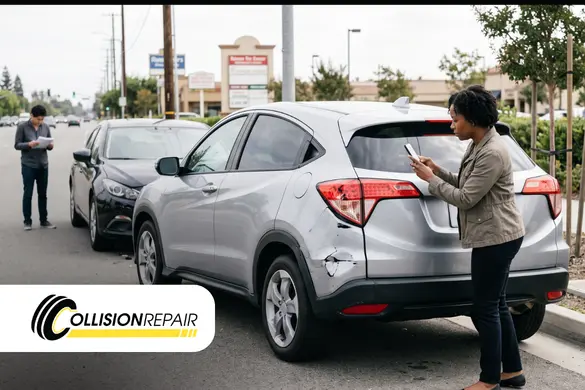
Getting involved in a vehicle collision introduces immediate stress, especially when you are completely blameless. Beyond arranging replacement transportation and coordinating vehicle evaluations, dealing with insurance financial requirements often raises pressing questions. Chief among them is whether you must hand over money for a policy deductible when someone else caused the damage.
Navigating insurance terminology, liability determinations, and auto body shop payments can feel complicated. Knowing your legal entitlements and how the insurance claim process operates allows you to protect your finances while keeping your vehicle restoration moving forward smoothly.
Do I Have to Pay My Deductible If the Accident Wasn’t My Fault?
No, not if you file with the at-fault driver’s insurer. You only pay a deductible if you file through your own collision coverage, and you can get it back later through subrogation.
The answer depends on which insurance company processes your repair claim. If you file directly against the negligent driver’s property damage liability insurance (a third-party claim) and their insurer accepts liability, you pay no deductible. Their policy covers all approved repairs, usually by paying the repair facility directly.
However, if you file through your own collision coverage to expedite repairs (a first-party claim), your policy contract requires you to pay your agreed-upon deductible upfront. Even when a deductible accident wasn’t my fault, the situation applies; your insurer enforces this contractual clause whenever they issue payouts under your policy. You recover these funds once your insurer collects reimbursement from the responsible party.
At-Fault Driver’s Insurance vs. Your Own Policy: Which Claim to File
A third-party claim avoids the deductible but can be slower. A first-party claim is faster but requires paying the deductible upfront. Deciding where to route your insurance claim involves balancing speed against out-of-pocket payments:
Third-Party Claim (At-Fault Party’s Insurer)
- Pros: No deductible payment required at vehicle pickup; rental vehicle expenses are billed directly.
- Cons: Repair authorizations can be delayed while adjusters investigate liability and contact their policyholder.
First-Party Claim (Your Insurer)
- Pros: Immediate teardown approvals, faster parts sourcing, and rapid vehicle intake at your preferred shop.
- Cons: You must pay your deductible upfront to the repair facility upon completion.
Under either option, California law prohibits an insurer from requiring you to use a specific repair shop (California Insurance Code § 758.5). If your vehicle is undrivable and you need immediate action, searching for a top-rated auto body shop near me helps you initiate an estimate while you determine the fastest claim avenue.
How to Get My Deductible Back After an Accident in California
When your insurer pays for your vehicle repairs on a first-party claim, they initiate a financial recovery legal process called subrogation. Through subrogation, your insurance carrier demands complete reimbursement from the negligent driver’s insurance company, which includes the out-of-pocket deductible you paid to the shop.
According to regulations enforced by the California Department of Insurance, insurance companies must pursue your deductible recovery with the same diligence as their own repair payouts. Once subrogation resolves successfully—typically within 30 to 90 days—your insurer mails you a check or issues a direct deposit refund. For broader insights on managing post-collision procedures, review our guide on choosing non-preferred body shops.
When the At-Fault Driver Is Uninsured: Deductible Waivers and UMPD
If an identified uninsured driver hits you, a Collision Deductible Waiver or Uninsured Motorist Property Damage coverage can protect you. In a hit-and-run, damage usually goes through your collision coverage, deductible included. When the at-fault driver is uninsured, standard third-party recovery becomes unavailable. Fortunately, California policyholders have specific options (California Insurance Code § 11580.26):
- Collision Deductible Waiver (CDW): This optional policy endorsement waives your collision deductible if an identified, uninsured driver is proven at fault.
- Uninsured Motorist Property Damage (UMPD): Provides coverage up to your policy’s UMPD limit for property damage if you lack collision coverage and the uninsured driver is identified.
In cases involving bodily injury alongside property damage, consulting a qualified California personal injury lawyer can help protect your overall legal rights and medical recovery alongside your vehicle claim.
What Happens to Your Deductible If Fault Is Shared
If fault is shared, you recover only the share of your deductible that matches the other driver’s percentage of fault. California follows a pure comparative fault standard. If claims adjusters determine you bear partial responsibility, such as 20% fault for a parking lot incident, your deductible recovery reflects that split.
In partial-fault cases, your insurer returns a pro-rata portion of your deductible corresponding to the other party’s percentage of legal liability. For example, with a $1,000 deductible and 20% fault on your side, you would recover $800.
Paying Your Deductible at the Auto Body Shop: What to Expect
You typically pay your deductible to the repair shop when you pick up your vehicle, and your insurer pays the rest of the approved repair cost. Deductibles are generally paid directly to the collision repair center when collecting your finished vehicle, not to an insurance adjuster. Reputable facilities accept major credit cards, certified checks, or insurance draft payments.
Be cautious of facilities offering to “absorb” or “waive” your deductible by inflating repair estimates. Under California law, submitting inflated or false billing to an insurer constitutes insurance fraud (California Penal Code § 550). Quality facilities assist you by documenting all physical damage accurately to help your carrier recover every dollar during subrogation. For further steps after a crash, explore our guide on immediate accident action items.