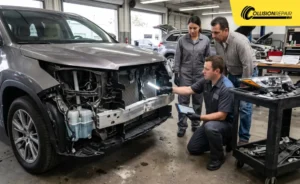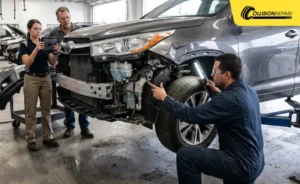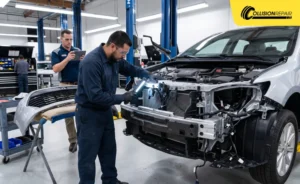
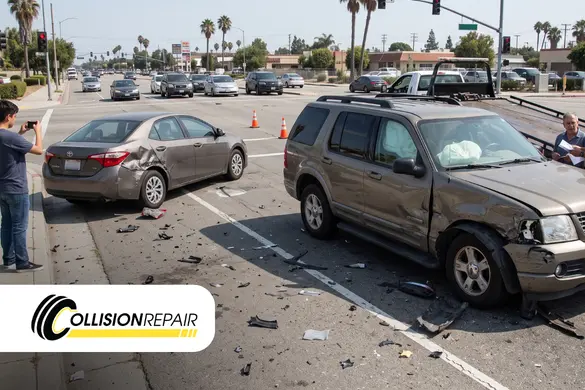
When your vehicle is heavily damaged and insurance companies blame each other, determining who pays for property damage after a car accident in California can feel overwhelming. While the legal rule clearly states the at-fault party pays, the practical reality depends heavily on coverage limits, deductibles, and whether the other driver is properly insured.
Who Pays: Scenario by Scenario
Scenario | Who Pays | Key Detail |
Other driver at fault, insured | Their property damage liability coverage | Required minimum: $15,000 (Veh. Code § 16056) |
You want repairs done fast | Your own collision coverage | Deductible refunded later via subrogation |
Fault is disputed | Split by percentage of fault | Pure comparative negligence (Li v. Yellow Cab) |
At-fault driver uninsured | Uninsured Motorist Property Damage (UMPD) pays up to $3,500 for repairs when an identified uninsured driver damages your car | UMPD requires the driver to be identified |
The at-fault driver was working | The employer’s commercial policy, typically | Larger limits often apply |
Damage exceeds their limits | The driver personally, for the balance | Small claims handles up to $12,500 |
The At-Fault Driver’s Property Damage Liability Coverage
California is a fault (tort) state: the driver who causes the crash and their insurer must pay for the property losses that follow, including your vehicle and its contents.
Every California driver must carry liability coverage, and the floor recently moved. Under SB 1107, effective January 1, 2025, the required minimums rose to $30,000 per injured person, $60,000 per accident, and $15,000 for property damage (Vehicle Code § 16056) — triple the old $5,000 property figure, with another increase already scheduled for 2035.
Better, but still thin. The average property damage liability claim reached $5,313 in 2022, per ISO data published by the Insurance Information Institute, and a newer vehicle totaled at $30,000 easily exceeds a minimum policy limit. When damage exceeds the at-fault driver’s limits, that driver is personally responsible for the balance, collectible in theory, and often the reason victims turn to their own coverage instead.
Using Your Own Collision Coverage
Waiting for a third-party insurer to investigate liability, review estimates, and cut a check can take weeks. If you need the car back now, you can file a first-party claim under your own collision coverage, which pays for damage to your vehicle regardless of fault.
Going first-party has two practical advantages: your own carrier typically approves estimates and issues repair payments faster, and if your policy includes rental reimbursement, the rental coverage starts immediately rather than after a liability decision.
And a protection many Californians don’t know they have: under the state’s Proposition 103 rating regulations (10 CCR § 2632.13), an accident that was not principally your fault cannot be counted against you to raise your rates or strip your Good Driver discount. Filing the claim to fix a crash someone else caused shouldn’t cost you at renewal.
Deductibles and Subrogation: Getting Your Money Back
The trade-off of the first-party route is the deductible, commonly $500 or $1,000, paid out of pocket to the shop. That payment is usually temporary.
After covering your repairs, your insurer opens a subrogation claim: a formal demand against the at-fault driver’s insurer to recover what it paid, including your deductible. When the money comes back, your deductible comes back with it. Straightforward cases resolve in weeks; disputed liability can stretch the process to months, but the claim on your deductible doesn’t expire while the carriers argue.
What Happens When The Fault is Disputed
Insurers constantly deny liability or assign shared blame, and that’s where the question of who pays for property damage after a car accident stops being a one-line answer. California applies pure comparative negligence under Li v. Yellow Cab Co. (1975), which holds that fault is divided by percentage, and your recovery shrinks by your share. Twenty percent at fault for $10,000 in damage means the other insurer owes $8,000; zero percent at fault means it owes all of it.
Percentages are won with evidence: the police report, dashcam and surveillance footage, scene photos, witness statements, and the vehicles’ event data recorders. When an adjuster inflates your share of fault to shrink the payout, that’s typically the moment people start typing “California auto accident attorney near me” — and it’s a reasonable instinct, because fault allocation is negotiable and adjusters know it.
Uninsured and Underinsured Drivers
Here’s the uncomfortable math: roughly 1 in 5 California drivers — 20.4% — carried no insurance in 2023, per the Insurance Research Council, one of the highest rates in the nation. Legal mandates don’t fix a hit from a driver with nothing to collect.
Your own policy offers two tools. Uninsured Motorist Property Damage (UMPD) pays up to $3,500 for repairs when an identified uninsured driver damages your car.
A deductible waiver endorsement goes further for those who carry collision coverage. It waives your collision deductible entirely when an identified uninsured driver causes the crash.
For damage beyond those figures, collision coverage carries the repair, and small claims court remains an option against the driver personally.
Proving the Amount: Estimates and Documentation
Establishing who pays is half the fight; the other half is proving how much. Get an independent written estimate from a certified body shop — Insurance Code § 758.5 protects your right to choose your own repair facility — and photograph every damaged panel, the frame, and any personal items destroyed in the crash. If your car is newer or high-value, put inherent diminished value on the table as well.